Saturday, February 17, 2007

Rhombi Tiling


The graph is about rhombi tiling an octagon shape, created by R. Kenyon and A. Okounkov. Finally, I figured out how to read the graph.
The graph is planar 2-D shape. But there are three possible orientations for a rhombi, straight up, left and right. These three orientations are painted by three different colors. As a result, if you pick the color properly, the graph looks like a 3-D one (block buildings). The genius thing here is that the third coordinate does not come in a natural sense (for example, directly proportional to color or some other parameter). Rather it seems a visual effect only without deep meaning. They further proved that for the random tiling, the 3D graph shows some patterns: The borders of the 3-D building approaches to some functions. The idea seems crazy at its first sight. However, it works very beautifully. The understanding of the deeper connection seems not easy though.

Monday, February 12, 2007

Euler Characteristic


Königsberg City Map and 7 Bridges
(Königsberg is a city of Prussia where Goldbach (Yes, the Goldbach Conjecture!) is born.)


The Swiss mathematician Leonhard Euler is one of the great mathematicians of all times. He used to live in a city called, Königsberg, which is a city divided into a few islands by several rivers. See the picture. It was at there that he put forward the Königsberg bridges problem (i.e. the sales man problem): One cannot cross all seven bridges just once for each.
TWF also made up a story for Euler to find the Euler characteristic formula, V - E - F. It goes like this... There used to be an isolated island in the city and there was no brige connecting it with the rest of the city. But one day, the city finally decided to build a brige to the island and Euler saw the construction. Then he thought, the number of the isolated islands is decreased by one due to the new bridge. Everybody can see this... Well, Euler did one step further: The bridge was acting as a negtive bridge. So, # islands - # bridges. One can another step further.. If there is a dock builded between the two bridges, the dock is then acting as a negative bridge, i.e. a positive island, # islands - # bridges + # docks. So comes the Euler characteristic V - E - F, where V stands for the number of vertices of a polyhedra, E stands for the edge (connecting vertices) and F for the face (connecting edges). Well, the story does not stop here if you imagine a higher dimensional world than 3-D. You may add some structure to connect two faces in a 4-D world and the formula repeats the alternative sigh pattern. The Euler characteristic is applied into counting the size of categories...
Just like this idea. Simple and clear.

Saturday, January 27, 2007

Ich liebe dich nicht du liebst mich nicht

Da da da I don’t love you you don’t love me
aha aha aha
(music und lyrics: Remmler/Kralle)

What you do and what you don't
What you will and what you won't
what you can and what you can’t
This is what you got to know
loved you though it didn’t show

Ich lieb dich nicht du liebst mich nicht

Da da da I don’t love you you don’t love me

I know why you went away
understand you couldn’t stay
wonder where you are today
after all is said and done
it was right for you to run

Ich lieb dich nicht du liebst mich nicht

Da da da I don’t love you you don’t love me

Wednesday, January 24, 2007

Guess what happens next?

It has been a while since the last post. Becuase the earthquake in Taiwan Strait broke the optic cable, the internet connection to the rest of the world from China has been almost completely lost. For that matter, I lost the time to earn more on my capital investment. At the same time, I have gained more recognition on other sides of life. You could never be exactly sure what will happen in the next second. The life stream may meet some rocks or merge with some creeks... The more important thing is to keep going and to execute what you wish you do before you lose the chance.
Keep on fighting, and let the drama of your life more colorful and exciting.
This post happens to be the first one in 2007. I wish myself and any vistors of this blog have a WONDERFUL year of 2007.

Saturday, December 23, 2006

Couple in Happiness


The man in the picture is Qin Tailai(秦泰来), who was one of the most famous photographer in 1930's Shanghai. The woman is his wife. The picture shows the happiness and the serenity of the couple. Qin pioneered in photograph business and naked women photographing.

Sunday, November 26, 2006

Wedding Decoration


Nov 26, 2006; 10-06-2006 on the Chinese Calendar. A good day for marriage.
Taken in Sanjiang Town, Chongzhou County, Chengdu, China

4-D Universe


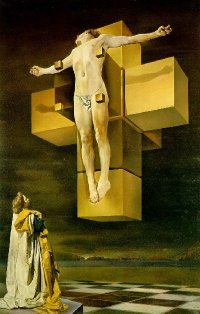
Salvador Dali, one of the greatest painters of the world in 20th century, loves high-dimensional abstract concepts. Many of objects and ideas in his works can only be realized in a wolrd with a dimension higher than 3. One example is that one of his late work, the hypercube cross, in which the cross is consist with 8 cubes. The 8 cubes together actually represents a cube in a 4-dimensional space. Or more exactly, it is an fold-out in 3-dimensional space.
To understand this point, we can apply the same method to construct a 3-d cube from six 2-d 'cubes', i.e. squares. That is the way how a box can be built out of paper.

Instead of using squares, we can also use pentagons to construct a 3-d object and we will get a solid shape called dodecahedron. And 12 pentagons are needed for the purpose.
Like that 8-cubes can construct to a hypercube, can we get something interesting if we were able to stack many dodecahedrons together in a 4-d space? The answer is yes. The object is called '120 cells'. It needs 120 dodecahedrons to fill all the space inside. You may wonder how to imagine how such a object look like...? Well, you need to put five layers of dodecahedrons on top of each other and you will get a fold-out represenation of the object, just like the Dali holy cross for the hypercube. Then, in the four-timensional world, you need to squeeze the dodecahedrons and stick the faces of the dodecahedrons together. Below is a beautiful picture of the fold-out version of the 120-cell available from Wikipedia.

120-cell made with 120 dodecahedras, projected in 3-D space and depicted on a 2-d sheet.